Showing posts with label Boyko. Show all posts

Sunday, July 28, 2019

Roztoka, Ukraine

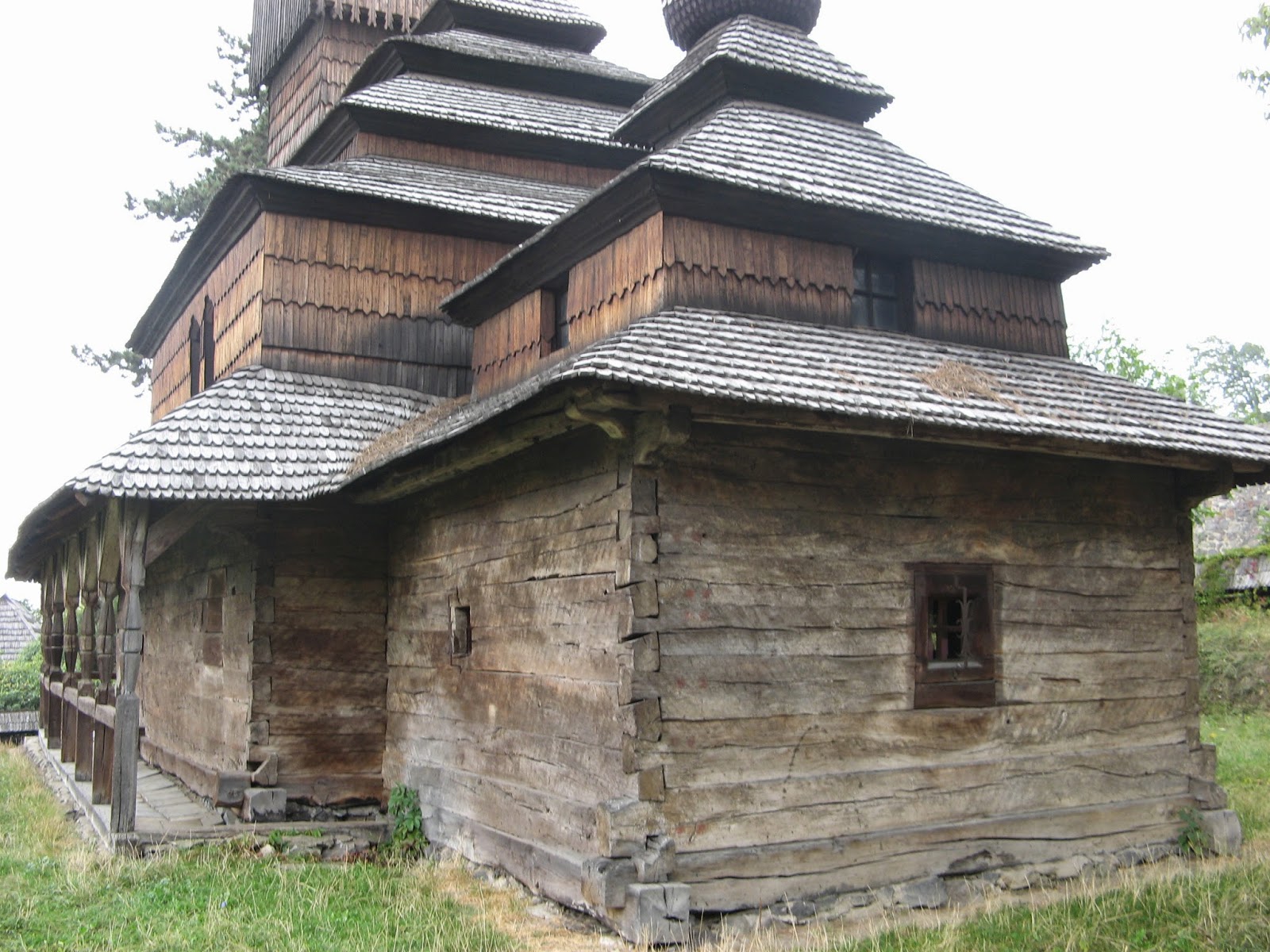
The small village of Roztoka lies in the foothills of the Carpathians in a remote and rustic corner of Ukraine's Zakarpattya region. Located several kilometres off the main road between Volovets and Mizhhirya, the village stretches along a valley with the Church of the Blessed Virgin Mary a short climb up the embankment from the roadside. The church sits on a very steep incline with the doorway facing uphill with the bell tower directly in front and a small cemetery along the side.
Originally constructed in the 1600's, the church has changed its appearance several times in its history. The original structure had a Boyko design with three steeples above the roof of the nave with the tallest placed in the centre. In 1759 the church was rebuilt in a Baroque style with the single square-sided tower above the entrance seen today. At some point the original porch entrance with its wooden columns were replaced with a modern enclosed verandah with glass windows.
The interior of the church is mostly empty, since the villagers sold the iconostasis and some of the icons in 2001 and the rest of the interior fittings were moved to another more modern church in the village. As a result the wooden church is not used for regular religious services and is seldom opened. The structure of the church was in danger of collapsing in the early 2000's but efforts to stabilize the roof were successful following restoration work conducted in 2005.
The current wooden bell tower dates from the eighteenth century, though an older structure likely stood on the same spot. Its square floor plan with two levels and an octagonal roof above is typical for the region and many of the surrounding villages have church bell towers with a similar appearance.
Getting to Roztoka is challenging by public transport, though minibuses run several times per day between Volovets and Mizhhirya and stop at the turnoff point for the village. From the bus stop it's a walk of about three kilometres along the road up the valley to reach the church, which is hidden in a clump of trees on the left-hand side. Finding the person who keeps the keys for the church proved challenging during my visit, I was unable to see the interior despite asking several villagers.

Monday, October 12, 2015

Kostryna, Ukraine


Kostryna is a small village in the north-western part of Zakarpattya region in Ukraine, close to the borders with Slovakia and Poland. The church stands at the top of a hill above the village in a clearing among the trees. New wooden steps added in 2013 lead the way up the hill from the road. The church is a fascinating example of a hybrid architectural style encompassing both Boyko and Lemko elements in its design. This is apparent in the large, dominant central tower above the nave, a feature of Boyko design, combined with the three towers descending in height from the bell tower above the entrance area, a feature of Lemko style.


The Church of the Intercession was built in 1761 and the original structure is a fine example of Boyko design. However, the addition of a taller bell tower above the entrance area in place of the original tower converted the style of the church from Boyko to Lemko, showing the dominant influence of Lemko style in this region in the early nineteenth century. This modification likely occurred around the year 1800. The largest bell in the tower was taken and melted down as part of the war effort in the Hungarian revolution of 1848, and was later replaced with a new bell in 1899.


According to some accounts the church originally stood in a nearby village and the people of Kostryna purchased it and moved it to its present location in 1703. The church has been lucky to survive until the present day; in the 1860s the villagers planned to replace the wooden church with a new stone church on the same site, but a lack of funds prevented this from happening. Enough money for a new stone church was finally collected by 1914, but the outbreak of World War One stopped construction, and following the war devaluation of the currency they had collected prevented construction of a stone church yet again.


Kostryna can be reached from Uzhgorod by elektrichka (regional train) or by marshrutka (minibus). There are several buses and trains per day travelling in each direction, so making a day trip to Kostryna from Uzhgorod by public transport is possible. The minibuses are usually very full and often uncomfortable, so the train is a more pleasant way to travel there. The beautiful mountain scenery in the region is more easily seen from the windows of the train as well.

Saturday, June 7, 2014

Tarnoszyn, Poland (Now in Lublin Outdoor Museum)


This Greek-Catholic wooden church is dedicated to the Nativity of the Blessed Virgin Mary and is now located in the Outdoor Folk Architecture Museum in Lublin, Poland. The church was originally constructed in 1759 in the village of Uhrynów (Uhryniv in Ukrainian) which is now part of Ukraine.


In 1904 the church was moved further west to the village of Tarnoszyn, which today lies in Poland just a few kilometres from the Ukrainian border. Following the expulsion and resettlement of the Greek-Catholic population of the village following World War Two, the church was used for Roman Catholic services until the early 1960's. Over the following decades the church was abandoned and fell into ruin.


In 1994 the church was purchased by the Greek Catholic parish in Lublin, and in 1997 it was transported to its present site in the Lublin Outdoor Museum. Extensive renovations were carried out between 1999 and 2001, and the interior fittings including the iconostasis were completely reconstructed.


The church features a classic Boyko style with a three-part design (nave, narthex and sanctuary) each topped by a dome with the largest dome placed above the nave. The design of the entrance area with a porch and four pillars is very unusual and is likely not an original feature of the building plan. The lowest part of the structure reveals the original horizontal log construction while the upper portions are covered in a modern vertical timber facade. Next to the church there is a large wooden bell tower which was also transported from Tarnoszyn and includes a cone-shaped roof over the bells.


The Lublin Outdoor Museum is located in the north-western suburbs of the city and can be easily reached by city bus from the old town. The museum is very large, you could spend most of a day seeing all of the different building styles and regions which are displayed.

Monday, April 21, 2014

Uzhgorod, Ukraine


This Greek Catholic wooden church stands in the Outdoor Museum of Folk Architecture in Uzhgorod, Ukraine. The church was originally constructed in 1777 in the village of Shelestovo near the city of Mukachevo, and was dedicated to Saint Michael. In 1927 the church was moved to Mukachevo, where it was later neglected during the early Soviet period. The church was transferred to the Uzhgorod museum in the 1970's to form the centrepiece of the museum's collection of Transcarpathian folk buildings.


The church is an outstanding example of the Lemko style of architecture, with its three onion domes arranged with the highest above the narthex (entrance area) a middle dome above the nave and the lowest dome above the sanctuary. There are only a few remaining examples of the Lemko architectural style in Ukraine, since the style is more commonly seen further west in the Carpathians in what today are Slovakia and Poland. Three Lemko churches were moved to what today is the Czech Republic while Transcarpathia was part of Czechoslovakia between the World Wars. Two other Lemko churches which are still in Ukraine have been transferred to the Outdoor Museums in the capital Kiev and in Lviv. A further example of the style is in the town of Svalyava, where the large church of St. Nicholas can be seen.


The tall and slender 22 metre Baroque tower is one of the finest features of the church, and it is topped with a decorative cross above the onion dome. This feature is repeated with crosses featuring intricate metalwork designs found above all three of the onion domes. The square pagoda-style series of roof layers above the nave are wonderfully proportioned in conjunction with the smaller tent roof over the sanctuary. The walls of the church are made of oak beams which are fastened together with dovetail joints in each of the corners.


The carved wooden posts which form a balcony around the entrance door and along the sides of the narthex and the nave are typical of the central Transcarpathian style where northern Lemko and Boyko elements mixed with design features seen further south in areas influenced by Romanian builders. Most of the original icons and the iconostasis wall from the original Shelestovo church have been lost, and the icons displayed in the church today as part of the Outdoor Museum were brought from the church in the village of Kolochava in the Carpathian highlands. These icons date from the 18th century.


The Outdoor Museum of Folk Architecture is a short walk from the centre of Uzhgorod, with the main entrance lying just beyond Uzhgorod castle. Uzhgorod is located at a crossroads of different countries and Poland, Slovakia, Hungary and Romania all lie within easy reach. Buses cross the border to Košice in Slovakia several times daily. Minibuses travel south to Chop near the Hungarian border where international trains depart for Budapest. Buses and minibuses run at least every hour to the neighbouring city of Mukachevo and there are direct trains heading north to Lviv.

Wednesday, January 29, 2014

Uzhok, Ukraine

This small church, found in a remote corner of the Carpathian highlands of Ukraine, was declared a UNESCO world heritage site in 2013 together with fifteen other tserkvas in Ukraine and Poland. The village of Uzhok lies in the Uzhok pass, the highest pass in this part of the Carpathians and one of the most scenic locations in Transcarpathian Ukraine. The church is one of the most famous in the region and often features in tourism and other promotional materials as a symbol of Transcarpathian Ukraine.
The church was built in the Boyko style in 1745 and dedicated to Saint Michael. Supposedly the church was originally placed higher up the slope of the hill, but it was moved down nearer to the road because it was difficult for elderly villagers to walk up the incline. The architectural proportions of this church make it one of the most perfect examples of the Boyko style of architecture. The large triple-layered roof above the nave stands above the smaller single-layered roof of the narthex and the double-layered sanctuary roof. The shape of the tower above the narthex is similar to that of churches in the Lemko style found a little further to the west in the Carpathians.
The brightly coloured interior has had several modern additions to its fittings and decorations, but still has a pleasing appearance overall. The 18th-century iconostasis has luckily been only slightly altered from its original appearance. The elegant windows with white framing are not an original feature and were added during a later renovation. The church exterior is covered in a dark coating of oil stain to protect the wood, and this has led to the church being referred to locally as 'the little black ship'.
Standing next to the church is a wooden bell tower, though its roof and upper walls are now covered in metal rather than wooden shingles. During World War One the government of Austro-Hungary (the state to which Uzhok belonged at that time) had the bells from the bell tower removed and melted down for military use. On the slope above the church is the village cemetery, with many older graves overgrown by grasses and trees.
The village of Uzhok is most easily reached by train, since there are several regional trains daily from Uzhhorod which run directly there. A few trains daily also continue onwards to Lviv to the north. There are a couple of buses and marshrutkas which run to the village daily from Uzhhorod, but the timing of the trains is more convenient to make a comfortable day trip. Just before arriving at the platform for Uzhok the train crosses a spectacular rail bridge across the valley, offering excellent views in all directions.

Sunday, November 18, 2012

Hoszowczyk, Poland

This formerly Greek-Catholic wooden church dedicated to the Nativity of the Virgin Mary lies in the small village of Hoszowczyk in the south-eastern corner of Poland, just a few kilometres from the Ukrainian border. It was built in 1926, making it one of the youngest wooden churches found in this region of the country.
The church is located in a part of the Carpathian mountains which was historically inhabited by Boykos (Rusyns) and it was constructed as a Boyko Greek-Catholic church, but its design shows direct influence of the Ukrainian Hutsul architectural style in its Greek cross-shaped floor plan and large central dome placed above the nave. The church in the neighbouring village of Hoszów also shows traces of the same Hutsul influence.
Following World War Two the Boyko population of the region was forcibly expelled, and Roman Catholic Poles were encouraged to settle in their place. The Communist authorities closed the church in 1951 and it was then used as a storage building. In 1970 the church was given to the local Roman Catholic parish, which refurbished the church and began using it to hold Roman Catholic services. During renovations made in 2002 a large cache of ammunition from World War Two was discovered hidden in the sanctuary.
Like many wooden churches in this region of Poland, the roofs and central dome are covered in a layer of sheet metal in place of the original wooden tiles. During the Communist period it was considered costly and unnecessary to maintain the wooden roofs, so sheet metal was used as a longer-lasting replacement. At present, several churches with metal roofs in Poland are being restored to their original all-wood appearance, but it will take many more years before this process is completed.
Directly beside the church there is a small former Greek-Catholic cemetery with a handful of tombstones, as well as several graves of World War Two soldiers. The church is not usually open to visitors without prior arrangement, though when I visited the caretaker was cleaning the carpets and she permitted me to go in. The interior contains modern Roman Catholic fittings and is of minimal historical interest.
The village of Hoszowczyk is not serviced by buses, but it is a two-kilometre walk west of Hoszów which is on the main road running south from Ustrzyki Dolne along which buses run quite frequently. Ustrzyki Dolne is connected by bus with Sanok, Krosno and the regional city of Rzeszów, which has onward train and bus connections with the rest of the country. Sanok makes a convenient base for a tour of the wooden churches in the region, as well as having the best outdoor architecture museum in Poland with four impressive wooden churches.