Showing posts with label Rusyns. Show all posts

Saturday, December 15, 2018

Huklyvyi, Ukraine

Huklyvyi is a small village located a few kilometres from the town of Volovets in a remote corner of Ukraine's Zakarpattia region. The Church of the Holy Spirit stands near the top of the village with a small stream running in front of it and forested hills behind. A crumbling wooden fence and a small grove of trees surround it and the accompanying bell tower. This is one of Zakarpattia's oldest and finest wooden churches, with beautifully proportioned contours.
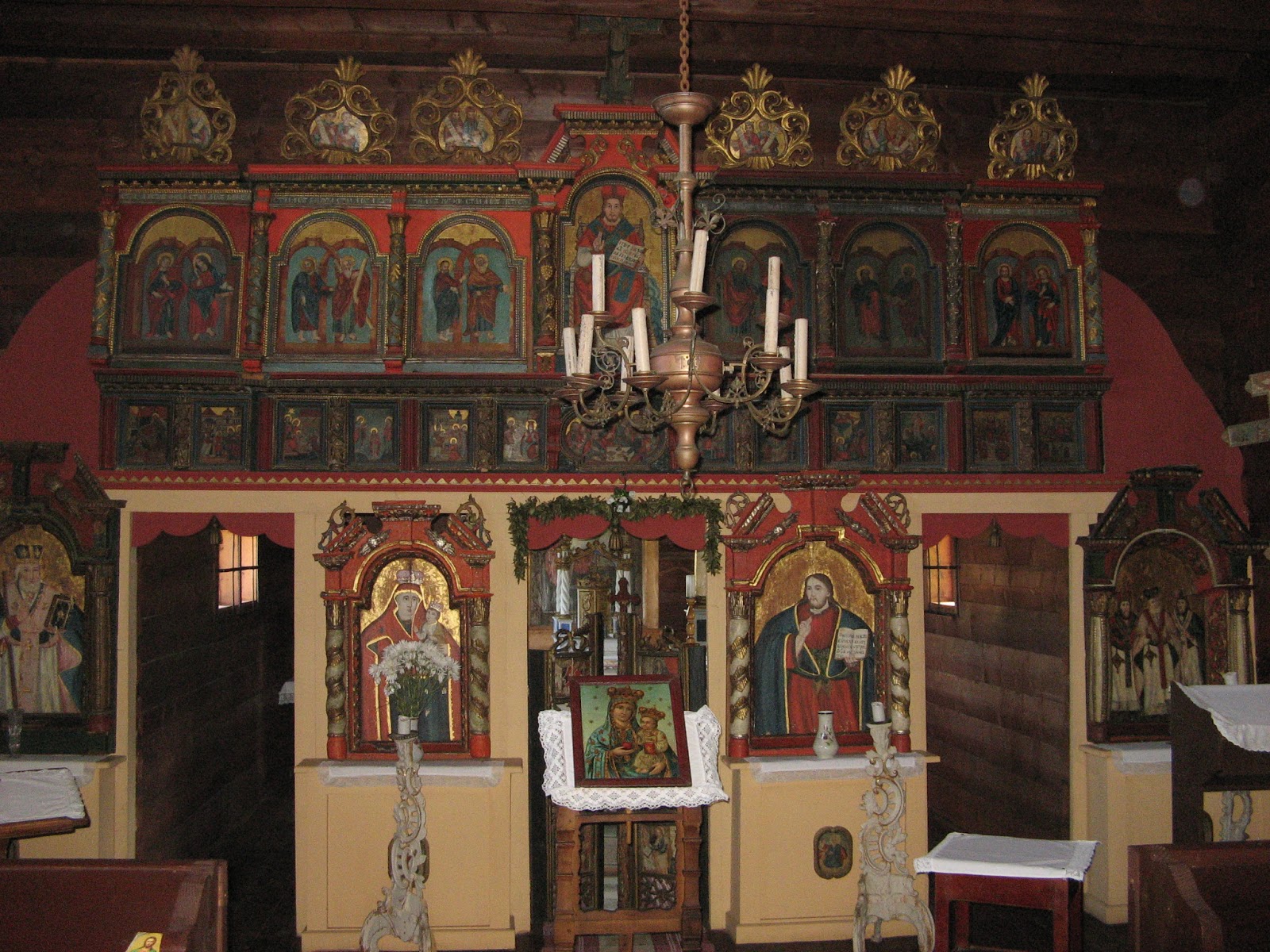
Built in the middle of the 18th century, the church represents an early phase in the development of the Boyko architectural style, before the broad adoption of the three-cupola domed design plan. The beautiful iconostasis inside dates from 1784.
During the Communist period the church was preserved as a "Museum of Atheism," which helped to protect its iconostasis and interior fittings. In 1970 the church underwent extensive restorations, but by the 1990s the church had fallen into disrepair and some of the roof shingles had rotted to the point where rain could penetrate inside the structure. Community funds were raised to fix the roof and in 2001 work began on a new shingle roof.
The eight-metre bell tower is tall and narrow, with a ladder providing access to an upper platform below the bells. A second bell tower once stood on the opposite side of the church, but it was torn down in the 1940s. Several old stone cross markers surround the church, most are marked with dates from the early 1800s.
Getting to Huklyvyi by bus or marshrutka requires some advance planning with the timetables, but isn't too difficult. Buses from Uzhhorod and Mukacheve run to the nearby town of Volovec several times per day, and local marshrutkas head south quite regularly covering the 5 kilometres to the Huklyvyi bus stop. From there walk up the hill through the village about one kilometre to reach the church. The keys are theoretically kept by the family who live next door to the church, though I was unable to find anyone who could open it during my visit.

Wednesday, October 21, 2015

Nehrovets, Ukraine


Nehrovets is a small village in the Zakarpattya region of western Ukraine, close to the larger village of Kolochava and 40 kilometres north of the small city of Khust. The church stands on a low hill above the central part of the village, with tall trees making it hard to see from the road. Views of the peaks and ridges of the Carpathian mountains to the north make an impressive backdrop for the church and separate wooden bell tower.


The church is dedicated to Saint Michael the Archangel and was built during the eighteenth century. It is constructed primarily of spruce wood. The floor plan of the church features three rooms and there are three distinct roof lines above, making it an example of the Boyko architectural style. The height of the tower and the steeple above it dominate the structure, yet the overall design retains well-balanced proportions. An inscription indicates that in 1918 the church was moved to the present location and received a new roof and tower at that time.


The church interior contains a modern iconostasis and icons, though several historical icons from the 18th century have also been preserved. A large two-storey bell tower stands at the top of the steps leading up from the road. The bell tower has a shape which is typical for the 'Verkhovina' highlands of this region, though it is in a much better state of preservation than most others. A modern wooden church stands beside the historical one and serves as the main place of worship for the local villagers.


Nehrovets is difficult to reach by public transport, the best option is to walk the two kilometres along the road from the neighbouring village of Kolochava which has limited bus and marshrutka connections to Khust. In the morning marshrutkas also go from Nehrovets to the nearby town of Mizhhirya. The road through the village is paved but it is not in good condition. The keeper of the church keys lives across the road from the church, though I was unable to locate them during my visit.

Monday, October 12, 2015

Kostryna, Ukraine


Kostryna is a small village in the north-western part of Zakarpattya region in Ukraine, close to the borders with Slovakia and Poland. The church stands at the top of a hill above the village in a clearing among the trees. New wooden steps added in 2013 lead the way up the hill from the road. The church is a fascinating example of a hybrid architectural style encompassing both Boyko and Lemko elements in its design. This is apparent in the large, dominant central tower above the nave, a feature of Boyko design, combined with the three towers descending in height from the bell tower above the entrance area, a feature of Lemko style.


The Church of the Intercession was built in 1761 and the original structure is a fine example of Boyko design. However, the addition of a taller bell tower above the entrance area in place of the original tower converted the style of the church from Boyko to Lemko, showing the dominant influence of Lemko style in this region in the early nineteenth century. This modification likely occurred around the year 1800. The largest bell in the tower was taken and melted down as part of the war effort in the Hungarian revolution of 1848, and was later replaced with a new bell in 1899.


According to some accounts the church originally stood in a nearby village and the people of Kostryna purchased it and moved it to its present location in 1703. The church has been lucky to survive until the present day; in the 1860s the villagers planned to replace the wooden church with a new stone church on the same site, but a lack of funds prevented this from happening. Enough money for a new stone church was finally collected by 1914, but the outbreak of World War One stopped construction, and following the war devaluation of the currency they had collected prevented construction of a stone church yet again.


Kostryna can be reached from Uzhgorod by elektrichka (regional train) or by marshrutka (minibus). There are several buses and trains per day travelling in each direction, so making a day trip to Kostryna from Uzhgorod by public transport is possible. The minibuses are usually very full and often uncomfortable, so the train is a more pleasant way to travel there. The beautiful mountain scenery in the region is more easily seen from the windows of the train as well.

Wednesday, November 21, 2012

Hunkovce, Slovakia

This photogenic Greek-Catholic church stands on a small hill next to the road in the village of Hunkovce in north-east Slovakia. There are Rusyn wooden churches in nearly every village between the town of Svidník and the Polish border, but Hunkovce's church is the only one which can be easily seen from the main road while driving past. The church was built at the very end of the 18th century, probably in 1799, and was dedicated to the Dormition of the Virgin Mary.
The church has a perfect Lemko design plan, with the tallest of three towers above the narthex (entrance area), the middle one above the nave and the lowest above the sanctuary. Each of the towers features intricately detailed onion domes with large ornamented metal crosses in Baroque style placed above. The wooden structure of the building sits on a low stone foundation layer to protect it from water seepage from the ground.
There is a small Greek-Catholic cemetery on the hill surrounding the church, with several cast-iron cross markers that date from the late 19th and early 20th centuries. The small shingle-roofed entrance gate beside the road is all that remains of the traditional wooden fence which once surrounded both the church and cemetery.
The village of Hunkovce saw heavy fighting in the battle for the nearby Dukla Pass in 1944; most of the houses in the settlement were destroyed, and the church suffered extensive damage to the roof and walls. It was later repaired and named a National Heritage Landmark building in 1968. At the southern end of the village there is a large World War Two German military cemetery with the graves of more than 2000 German soldiers who fought in the battle.
In 2010 the exterior of the church was fully reconstructed with new wooden siding and roof shingles (these photos were taken a few months before the restoration). The church is empty and has no interior fittings because the iconostasis and icons were removed and placed in museums in Bardejov and Svidník. No religious services are held here, since there is a modern Greek-Catholic church across the road which serves this purpose for the local villagers. If you'd still like to see the inside of the wooden church, try to find the local priest who is often in the modern church across the road.
Hunkovce is one of the easiest churches to visit in Svidník region because it is directly on the main road to the Polish border and many buses travel along this route daily. The bus from Svidník takes about 20 minutes to reach the village, and it is another 25 minutes from there to the border. After crossing the border on foot, Polish buses run from the border to the towns of Dukla and Krosno. Svidník isn't very aesthetically pleasing, but it is the most convenient place to use as a base when visiting the wooden churches in this region, and the town also has a superb outdoor folk museum and the Ukrainian-Rusyn Cultural Museum.

Monday, November 19, 2012

Tročany, Slovakia

This newly restored church stands in the centre of the small village of Tročany, located south of Bardejov in eastern Slovakia. Research conducted during the past few years has confirmed that the church is much older than had been previously thought; samples taken from its wooden beams were tested and the date of its construction was found to be the end of the 15th century or the first years of the 16th century. This puts it into the same age bracket as the Roman Catholic church in Hervartov, previously believed to be the oldest surviving wooden church in Slovakia. It is among the oldest Greek-Catholic wooden churches in the entire Carpathian mountain region.
Dedicated to Luke the Holy Apostle and Evangelist, the church has a standard Greek-Catholic floor plan with a sanctuary, nave and narthex (entrance area). Above the entrance porch there is a bell tower topped with a very unusually shaped cap which looks like a candle extinguisher. A similarly shaped cap sits above the central nave, while the sanctuary has no cap or steeple attached. The bell tower contains two bells which are still in regular use during religious services. At the top of the cap of the bell tower is a simple double-barred cross, while the cap above the nave has a more decorative single-barred cross.
The interior contains a restored iconostasis from the 17th century, though it is missing some of its original features. Instead of the typical Last Supper scene placed above the middle Czar door there is the Mandilion, a picture of the face of Christ on a cloth without a crown of thorns. In the sanctuary the altar is decorated with an 18th century icon depicting the Descent from the Cross, while the preparatory table in the corner has an icon of Saint Michael the Archangel. There are small windows on the right-hand side of both the nave and the sanctuary which allow some natural light to enter.
Today the church is used by both Greek Catholics and Roman Catholics, so the interior contains some modern Roman Catholic fittings which thankfully do not detract from the beauty of the older Greek Catholic artifacts. The church has undergone several renovations throughout its history, with major work carried out in 1897, 1933 and 1968. In 2010 and 2011 the church was completely restored both inside and out with funding provided by the European Regional Development Fund as part of a cross-border project to promote economic growth and cooperation between south-eastern Poland and north-eastern Slovakia.
The key for the church is kept by a family which lives at the opposite end of the village; if you are standing at the church go left along the road, pass the turning point for the road out to the main highway, continue up the slight incline of the hill and the house is on the right, the second house past the village office. You need to open their front gate and walk up and knock on the door on the right side of the house. The family are used to opening the church every day for visitors and are very friendly (they even speak a word or two of English) and they have pamphlets and books for sale about the Greek-Catholic churches in the region.
Tročany is not serviced by regular bus transport, but it is a two kilometre walk from the village out to the main road running between Bardejov and Prešov, and there is a bus stop at the turnoff to the village where buses pass by every hour or two. Prešov is a major transport hub with train and bus connections throughout the country, while Bardejov is the best place to base yourself for a tour of the wooden churches found in its vicinity.

Sunday, November 18, 2012

Hoszowczyk, Poland

This formerly Greek-Catholic wooden church dedicated to the Nativity of the Virgin Mary lies in the small village of Hoszowczyk in the south-eastern corner of Poland, just a few kilometres from the Ukrainian border. It was built in 1926, making it one of the youngest wooden churches found in this region of the country.
The church is located in a part of the Carpathian mountains which was historically inhabited by Boykos (Rusyns) and it was constructed as a Boyko Greek-Catholic church, but its design shows direct influence of the Ukrainian Hutsul architectural style in its Greek cross-shaped floor plan and large central dome placed above the nave. The church in the neighbouring village of Hoszów also shows traces of the same Hutsul influence.
Following World War Two the Boyko population of the region was forcibly expelled, and Roman Catholic Poles were encouraged to settle in their place. The Communist authorities closed the church in 1951 and it was then used as a storage building. In 1970 the church was given to the local Roman Catholic parish, which refurbished the church and began using it to hold Roman Catholic services. During renovations made in 2002 a large cache of ammunition from World War Two was discovered hidden in the sanctuary.
Like many wooden churches in this region of Poland, the roofs and central dome are covered in a layer of sheet metal in place of the original wooden tiles. During the Communist period it was considered costly and unnecessary to maintain the wooden roofs, so sheet metal was used as a longer-lasting replacement. At present, several churches with metal roofs in Poland are being restored to their original all-wood appearance, but it will take many more years before this process is completed.
Directly beside the church there is a small former Greek-Catholic cemetery with a handful of tombstones, as well as several graves of World War Two soldiers. The church is not usually open to visitors without prior arrangement, though when I visited the caretaker was cleaning the carpets and she permitted me to go in. The interior contains modern Roman Catholic fittings and is of minimal historical interest.
The village of Hoszowczyk is not serviced by buses, but it is a two-kilometre walk west of Hoszów which is on the main road running south from Ustrzyki Dolne along which buses run quite frequently. Ustrzyki Dolne is connected by bus with Sanok, Krosno and the regional city of Rzeszów, which has onward train and bus connections with the rest of the country. Sanok makes a convenient base for a tour of the wooden churches in the region, as well as having the best outdoor architecture museum in Poland with four impressive wooden churches.

Saturday, November 3, 2012

Nová Polianka, Slovakia (now in Svidník outdoor museum)

On a hill above the town of Svidník in north-eastern Slovakia lies the Ukrainian and Rusyn Village Museum, a collection of farm buildings, windmills and other historical wooden structures gathered from the surrounding region. The highlight of the museum is the Greek-Catholic wooden church originally from the small village of Nová Polianka, a few kilometres south of Svidník.
The church was built in Nová Polianka by local craftsmen around 1766 (some sources suggest as early as 1763) and was dedicated to Saint Paraskeva. During World War II the church and the village were badly damaged, and a newer brick church built in the 1930's became the main place of worship for the villagers.
The wooden church continued to be used for services until 1960, but in 1961 its condition had deteriorated enough that it was torn down. In the 1980's plans were made to found the Ukrainian and Rusyn Village Museum in Svidník, and it was decided that the church from Nová Polianka should be fully reconstructed for the museum based on the original architectural plans.
Eighteenth-century icons and interior fittings were collected from several different Greek-Catholic churches in the region and used to decorate the interior of the rebuilt structure. The church was opened as a part of the Village Museum in 1986, and since 1993 occasional Greek-Catholic masses and other religious services have been held there.
Built from pine wood, the church has a three-section floor plan in the typical Lemko style, with three accompanying steeples and beautifully decorative wrought-iron crosses above. The steeples and crosses are arranged in height with the highest above the entrance room, the middle one above the nave, and the lowest one above the sanctuary.
The wooden walls of the interior of the original church in Nová Polianka were covered in paintings of scenes from the Bible, but these were not recreated for the church in the museum. The iconostasis dates from the early 18th century and came from a church in a nearby village. There is a royal door at the centre of the iconostasis but the deacon doors for the two side entrances into the sanctuary are missing.
Standing next to the church is a wooden bell tower with a pyramidal shingled roof and an onion-shaped steeple topped with a cross. Two bells have been installed in the tower and are rung on special occasions. surrounding the church and bell tower is a low wooden fence with a shingled top in the Rusyn style which is typical of this region of the Carpathians.
The Village Museum in Svidník is open daily except Mondays from the beginning of May until the end of October. A Rusyn-Ukrainian folk festival is held in the village museum every year in June, attracting thousands of visitors to the event. Svidník is not connected to the railway network, so the most convenient way to get there by public transport is by bus from Prešov, Košice or Bardejov. Regular buses also run north from Svidník to the border with Poland at the Dukla Pass, where it is possible to catch a bus on the Polish side to the town of Krosno.

Tuesday, October 30, 2012

Kožany, Slovakia


The small village of Kožany lies in rolling countryside surrounded by fields and forests in a remote region of north-eastern Slovakia, between the towns of Bardejov and Svidník. This small Greek-Catholic church sits on a low hill at the western end of the village, with views across the surrounding farmland.


Dedicated to the Lord's Meeting with Simeon, the church was constructed in the second half of the 18th century by local builders. The three-roomed structure sits on a low stone foundation and features a bell tower above the entrance area. Three bells are kept in the tower and the oldest was cast in 1406, making it one of the oldest church bells to be found in Slovakia.


The inerior of the nave contains colourful paintings on the wooden walls, a unique feature among the timber churches in this region. The paintings were created between 1793 and 1797 and depict many scenes from both the Old and New Testaments. A Last Judgement icon on canvas, painted in the the late 18th century, is one of the most precious works found in the church.


The iconostasis dates from the beginning of the 18th century, and here again is a unique feature, since instead of a Czar door and two Deacon doors at the sides, there is a main Czar door and only one side Deacon door, likely because of the narrow width of the nave. The bars placed over the windows on the exterior of the church are another unique feature, since they are made of hand-crafted wrought iron and are as old as the church itself.


The key for the church is kept by a family which lives in a house several doors down from the church on the same side of the road. They charge a small entrance fee and have some books and pamphlets about the wooden churches in the region available for sale.


Getting to Kožany by public transport is possible, since there are several buses per day on weekdays which go to the village from Bardejov's main bus station (fewer on Saturdays and Sundays). Getting to Bardejov is easiest by bus from Prešov, Poprad or Košice, all of which have transport connections throughout the country.