Showing posts with label Svidník. Show all posts

Wednesday, November 21, 2012

Hunkovce, Slovakia

This photogenic Greek-Catholic church stands on a small hill next to the road in the village of Hunkovce in north-east Slovakia. There are Rusyn wooden churches in nearly every village between the town of Svidník and the Polish border, but Hunkovce's church is the only one which can be easily seen from the main road while driving past. The church was built at the very end of the 18th century, probably in 1799, and was dedicated to the Dormition of the Virgin Mary.
The church has a perfect Lemko design plan, with the tallest of three towers above the narthex (entrance area), the middle one above the nave and the lowest above the sanctuary. Each of the towers features intricately detailed onion domes with large ornamented metal crosses in Baroque style placed above. The wooden structure of the building sits on a low stone foundation layer to protect it from water seepage from the ground.
There is a small Greek-Catholic cemetery on the hill surrounding the church, with several cast-iron cross markers that date from the late 19th and early 20th centuries. The small shingle-roofed entrance gate beside the road is all that remains of the traditional wooden fence which once surrounded both the church and cemetery.
The village of Hunkovce saw heavy fighting in the battle for the nearby Dukla Pass in 1944; most of the houses in the settlement were destroyed, and the church suffered extensive damage to the roof and walls. It was later repaired and named a National Heritage Landmark building in 1968. At the southern end of the village there is a large World War Two German military cemetery with the graves of more than 2000 German soldiers who fought in the battle.
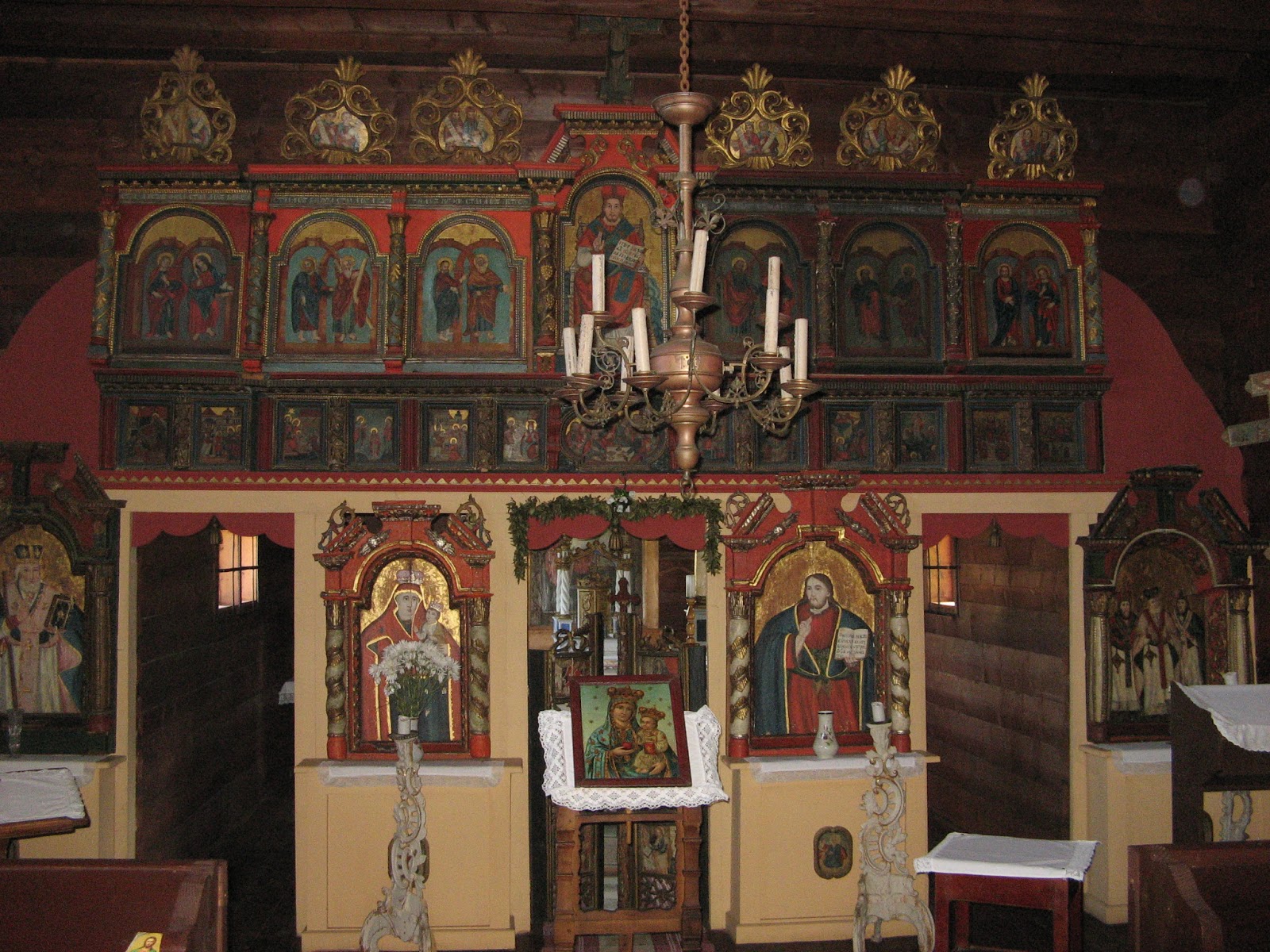
In 2010 the exterior of the church was fully reconstructed with new wooden siding and roof shingles (these photos were taken a few months before the restoration). The church is empty and has no interior fittings because the iconostasis and icons were removed and placed in museums in Bardejov and Svidník. No religious services are held here, since there is a modern Greek-Catholic church across the road which serves this purpose for the local villagers. If you'd still like to see the inside of the wooden church, try to find the local priest who is often in the modern church across the road.
Hunkovce is one of the easiest churches to visit in Svidník region because it is directly on the main road to the Polish border and many buses travel along this route daily. The bus from Svidník takes about 20 minutes to reach the village, and it is another 25 minutes from there to the border. After crossing the border on foot, Polish buses run from the border to the towns of Dukla and Krosno. Svidník isn't very aesthetically pleasing, but it is the most convenient place to use as a base when visiting the wooden churches in this region, and the town also has a superb outdoor folk museum and the Ukrainian-Rusyn Cultural Museum.

Saturday, November 3, 2012

Nová Polianka, Slovakia (now in Svidník outdoor museum)

On a hill above the town of Svidník in north-eastern Slovakia lies the Ukrainian and Rusyn Village Museum, a collection of farm buildings, windmills and other historical wooden structures gathered from the surrounding region. The highlight of the museum is the Greek-Catholic wooden church originally from the small village of Nová Polianka, a few kilometres south of Svidník.
The church was built in Nová Polianka by local craftsmen around 1766 (some sources suggest as early as 1763) and was dedicated to Saint Paraskeva. During World War II the church and the village were badly damaged, and a newer brick church built in the 1930's became the main place of worship for the villagers.
The wooden church continued to be used for services until 1960, but in 1961 its condition had deteriorated enough that it was torn down. In the 1980's plans were made to found the Ukrainian and Rusyn Village Museum in Svidník, and it was decided that the church from Nová Polianka should be fully reconstructed for the museum based on the original architectural plans.
Eighteenth-century icons and interior fittings were collected from several different Greek-Catholic churches in the region and used to decorate the interior of the rebuilt structure. The church was opened as a part of the Village Museum in 1986, and since 1993 occasional Greek-Catholic masses and other religious services have been held there.
Built from pine wood, the church has a three-section floor plan in the typical Lemko style, with three accompanying steeples and beautifully decorative wrought-iron crosses above. The steeples and crosses are arranged in height with the highest above the entrance room, the middle one above the nave, and the lowest one above the sanctuary.
The wooden walls of the interior of the original church in Nová Polianka were covered in paintings of scenes from the Bible, but these were not recreated for the church in the museum. The iconostasis dates from the early 18th century and came from a church in a nearby village. There is a royal door at the centre of the iconostasis but the deacon doors for the two side entrances into the sanctuary are missing.
Standing next to the church is a wooden bell tower with a pyramidal shingled roof and an onion-shaped steeple topped with a cross. Two bells have been installed in the tower and are rung on special occasions. surrounding the church and bell tower is a low wooden fence with a shingled top in the Rusyn style which is typical of this region of the Carpathians.
The Village Museum in Svidník is open daily except Mondays from the beginning of May until the end of October. A Rusyn-Ukrainian folk festival is held in the village museum every year in June, attracting thousands of visitors to the event. Svidník is not connected to the railway network, so the most convenient way to get there by public transport is by bus from Prešov, Košice or Bardejov. Regular buses also run north from Svidník to the border with Poland at the Dukla Pass, where it is possible to catch a bus on the Polish side to the town of Krosno.